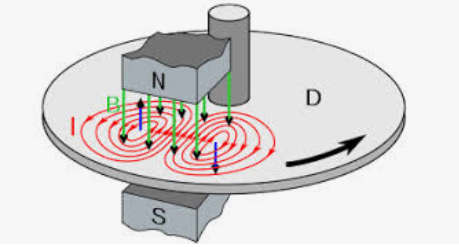
Eddy current loss in permanent magnets occurs when changing magnetic flux induces currents in electrically conductive material. Assess it using the field waveform, frequency, geometry, resistivity and cooling conditions. Magnet segmentation may reduce losses, but its effectiveness must be checked for the application.
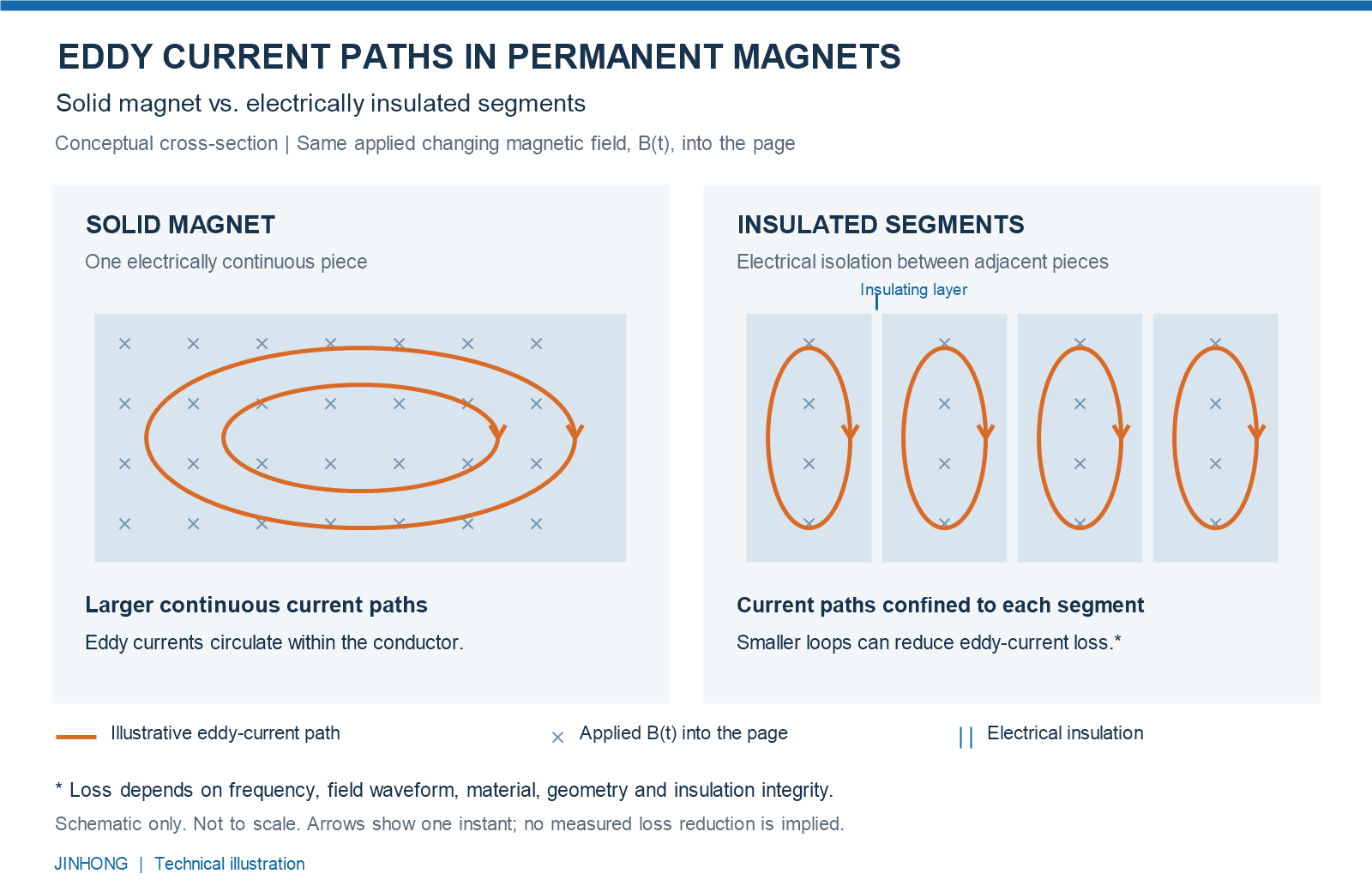
Conceptual comparison of eddy-current paths. Electrical insulation confines currents to individual segments; actual losses depend on the applied field, frequency, material, geometry and insulation integrity. Schematic only, not measured performance data. View full-size diagram.
What Is Eddy Current Loss
Eddy current loss occurs due to the interaction between a time-varying magnetic field and the electrical conductivity of the material. According to Faraday’s Law of Electromagnetic Induction, a changing magnetic flux induces an electromotive force (EMF) in a conductor. This induced EMF causes circulating currents within the material, resulting in Joule heating. Frequency-squared and thickness-squared scaling apply only under specified field, geometry and material assumptions; see the frequency discussion below. This loss can significantly impact the efficiency of electrical machines, making it crucial to control and minimize eddy current formation.
Key Factors Affecting Eddy Current Loss
Eddy current loss is influenced by several material and operational factors that impact energy dissipation and efficiency in electrical applications. Understanding these key factors helps engineers optimize material selection and design to minimize losses and enhance performance.
Electrical Conductivity
One of the primary factors influencing eddy current loss is the electrical conductivity of the material. High-conductivity materials, such as copper and aluminum, allow greater eddy current flow, leading to higher energy dissipation. Conversely, materials with lower electrical conductivity, such as ferrites, experience reduced eddy current loss. Engineers often choose materials with an optimal balance between conductivity and other magnetic properties to enhance efficiency.
Material Thickness
The thickness of the magnetic material plays a significant role in determining the magnitude of eddy currents. Thicker materials provide a larger path for circulating currents, increasing eddy current loss. This is why electrical transformers and motor cores are designed using laminated structures. These laminations, typically insulated from each other, restrict the flow of eddy currents and minimize losses. The thinner the laminations, the lower the eddy current loss, making this an effective strategy for improving energy efficiency.
Frequency of Magnetic Field
Frequency-squared scaling is an approximation under specified field, geometry and material assumptions. It is not a universal prediction for every permanent magnet or motor. Harmonics, skin effects and temperature-dependent properties can change the result; use an application-specific model or test for acceptance.
Magnetic Permeability
Magnetic permeability, which describes how easily a material can be magnetized, also influences eddy current loss. High-permeability materials, such as silicon steel and soft ferrites, are commonly used in transformers and inductors to improve efficiency. These materials facilitate better magnetic flux conduction while reducing unwanted eddy current effects. However, the choice of material must also consider other factors such as coercivity and hysteresis loss.
Temperature Effects
Temperature variations can significantly impact the electrical and magnetic properties of materials, affecting eddy current loss. As temperature increases, the resistivity of most metals rises, reducing eddy current loss. However, excessive heat can degrade insulation layers, leading to increased losses and material breakdown. Proper thermal management and cooling mechanisms are essential to maintaining material integrity and performance.
Methods to Reduce Eddy Current Loss
Minimizing eddy current loss is essential for enhancing the efficiency of electrical machines and magnetic materials. Engineers employ various strategies, such as material selection, structural modifications, and frequency control, to reduce energy dissipation. The following methods are widely used to mitigate eddy current effects and improve performance in industrial applications.
Use of Laminated Cores
One of the most effective ways to reduce eddy current loss is by using laminated cores in electrical machines. The lamination process involves stacking thin sheets of magnetic material with insulation between them, preventing large eddy currents from forming. This technique is widely used in transformer cores, electric motor stators, and generators to enhance efficiency and reduce energy dissipation.
Laminated soft-magnetic cores and segmented permanent magnets are different design cases. Do not treat transformer-core laminations as a direct manufacturing prescription for a finished permanent magnet. For segmentation, assess the segment dimensions, electrical isolation, field harmonics and thermal conditions together.
Choosing Low-Conductivity Materials
Materials with low electrical conductivity, such as ferrites, are preferred in high-frequency applications to minimize eddy current loss. Ferrites are commonly used in inductors and transformers due to their high resistivity and excellent magnetic properties. These materials help maintain efficiency while reducing the thermal impact of eddy currents.
Optimizing Material Thickness and Design
Reducing the thickness of magnetic materials or using specialized geometries can help control eddy current loss. Engineers employ design strategies such as using slotted cores, segmented structures, and composite materials to optimize performance. Advanced simulation tools and modeling techniques aid in determining the best configurations for minimizing energy loss.
Frequency Management
Controlling the frequency of operation is another effective way to mitigate eddy current loss. In some applications, operating at lower frequencies can help reduce energy dissipation. Additionally, selecting materials with properties tailored for specific frequency ranges ensures better efficiency and performance in electrical devices.
Applications and Industry Relevance
Eddy current loss plays a crucial role in various industries, particularly in the design and optimization of electrical machines. In power transformers, minimizing eddy current loss improves energy efficiency and reduces operational costs. In electric motors, lower losses contribute to higher performance and prolonged lifespan. Additionally, induction heating applications rely on controlled eddy current generation for precise temperature management.
Conclusion
For a permanent-magnet enquiry, send the component drawing, candidate material, magnetization direction, operating-temperature range and available field-frequency or waveform data. State any loss or temperature-rise acceptance requirement. JINHONG can review the component supply requirements; an application-specific loss reduction must be validated before it is quoted as a performance result.
Frequently Asked Questions
Does dividing a permanent magnet into more segments always reduce eddy current loss?
No. The result depends on segment geometry, electrical isolation and the applied field, including its frequency content. Compare the proposed design using a suitable model or test instead of assuming that more segments always give lower losses.
What should I provide when requesting magnets for an application with changing magnetic fields?
Provide the drawing, material or grade, magnetization direction, temperature range and available field waveform or frequency data. Include assembly and cooling constraints, plus any loss or temperature-rise acceptance requirement.